Kalshi fees: the number that quietly eats your spread
Kalshi’s taker fee is not a flat percentage. It changes with the price, and on a tight pair that small formula can decide whether the trade is worth doing.
Most fee explanations stop at “Kalshi charges 7%”. That is not quite right, and the difference matters when your edge is two or three percent.
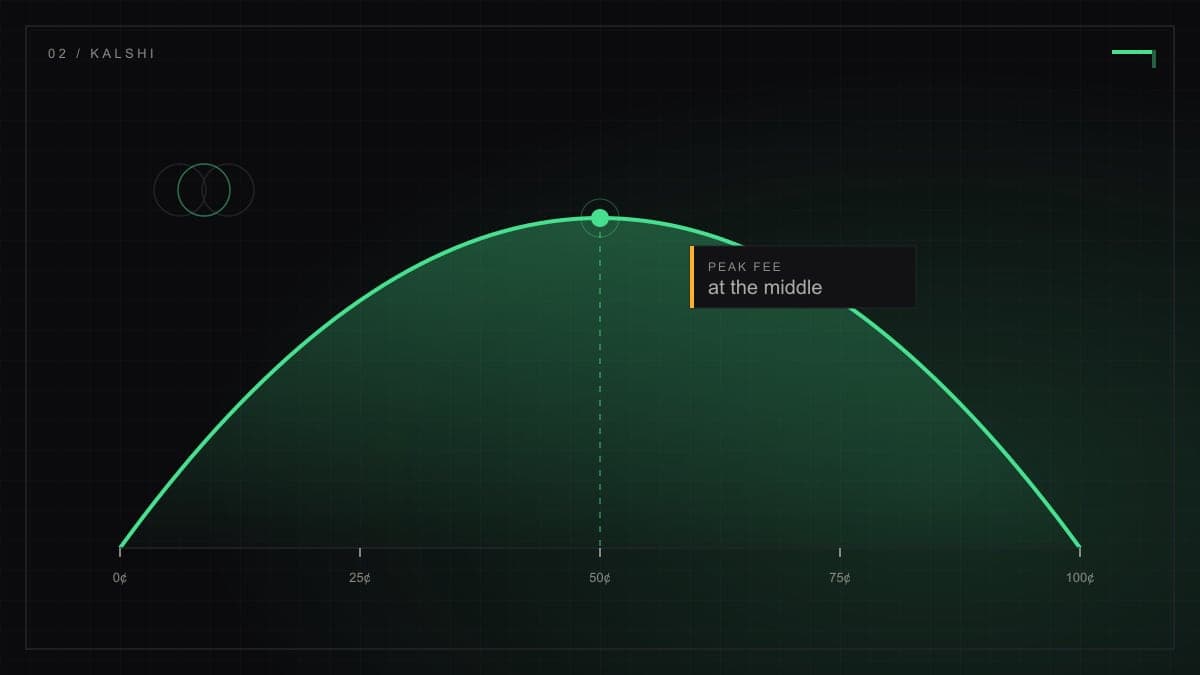
Kalshi’s published taker fee is based on 0.07 × p × (1 − p) per contract, where p is the price. At 50¢ the fee is highest, about 1.75¢ per contract before rounding. At 5¢ or 95¢ it is much smaller. The exact charge is rounded, and the schedule can change, so check the current fee page before sizing a trade.
Why the middle is expensive
A contract at 50¢ is the most uncertain, and the formula charges the most there. If you buy YES at 50¢ and NO on another venue for 46¢, the pair costs 96¢ before fees. Add roughly 1.75¢ on the Kalshi leg and the edge shrinks. Add rounding, the other leg’s fee and a little slippage, and a 4% spread can become a 2% spread.
| Price | Approx fee per contract | Effect on a tight pair |
|---|---|---|
| 5¢ | 0.33¢ | small |
| 25¢ | 1.31¢ | noticeable |
| 50¢ | 1.75¢ | the worst case |
| 75¢ | 1.31¢ | noticeable |
| 95¢ | 0.33¢ | small |
The table is a guide, not a quote. Kalshi rounds, and the exact fee can differ by an order. The point is the shape: the middle of the price range is where fees bite.
The fee is not the only cost
There is also the gap between bid and ask, the depth at the quote, and the time your money is locked. A 1% fee on a trade that resolves in two days is a different cost from a 1% fee on a trade that resolves in six months. That is why the scanner shows ROI and APR side by side.
A quick checklist
- ✓What is the current Kalshi fee at this price?
- ✓Does the fee change with the order size or the market?
- ✓What does the other venue charge?
- ✓Is the remaining edge still worth the capital lock-up?
- ✓Did you check the rulebook for this specific market?
If the answer to the last question is no, stop. Fees are deterministic. Resolution rules are not.
Kalshi’s formula is public and simple once you see it. The mistake is treating it as a flat 7% and finding out the real number after the trade.
The team behind the scanner. We write about cross-venue pricing, resolution rules and the mechanics of locking in spreads on prediction markets.