Limitless: quiet books, wide spreads, and a fee you have to estimate
Limitless is smaller than Polymarket and Kalshi, and that changes how you read a quote. Here is what to check before treating a Limitless price as real.
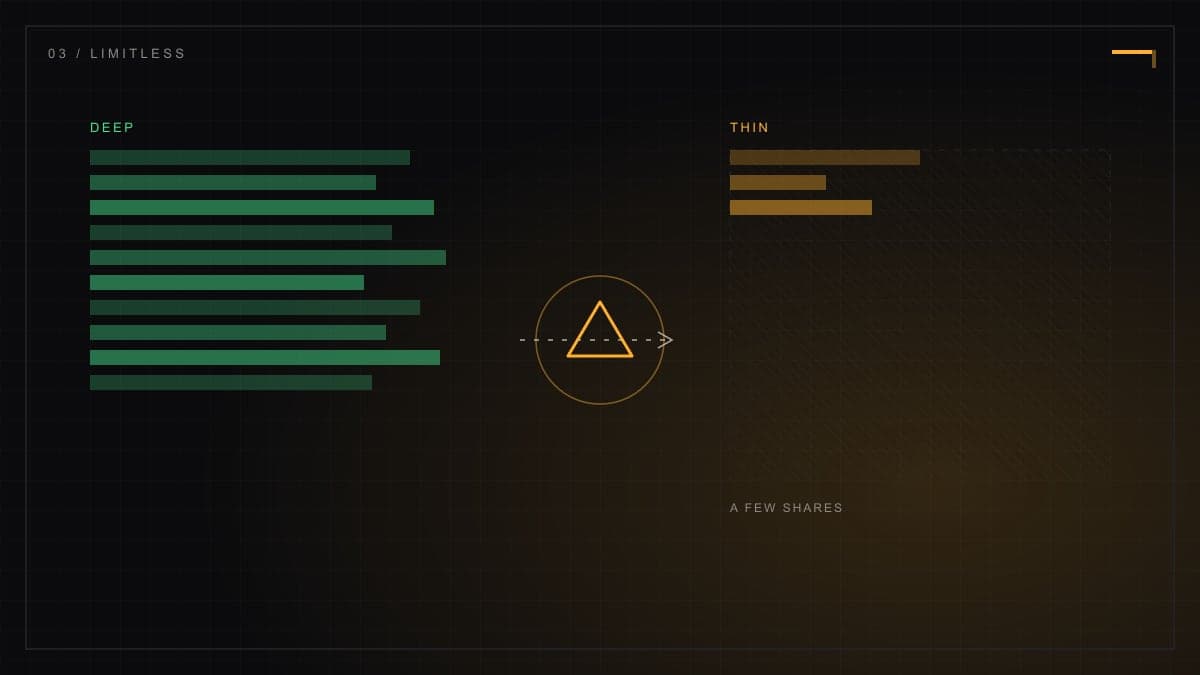
Limitless has fewer markets and thinner books. That is not automatically bad. It is the reason a Limitless quote can look like a bargain. It is also the reason a 300% ROI on Limitless is usually a warning, not a gift.
Two kinds of market
Some Limitless markets run on an AMM, some on an order book. An AMM quote moves as you buy. An order-book quote is only good for the size resting at that price. The API can give you a “market buy” number that looks firm but is really an estimate. The scanner refines it against the order book when a book is available.
The fee is not in the API
Limitless does not publish a per-market taker fee in the market payload we read. The scanner uses a fee rate from an environment setting. If that rate is wrong, every Limitless ROI is wrong. Treat Limitless numbers as estimates until you have checked the current fee schedule yourself.
Why huge ROI shows up here
A small book can leave a stale ask sitting for minutes. The scanner sees 2¢ on one side and 11¢ on the other and reports a large edge. Sometimes that is real. Often it is a quote that moves the moment you try to fill it, or a market with different resolution rules. The match score helps, but it cannot read the rulebook.
- ▪Check the match score, then read both rules.
- ▪Check the size at the quoted price.
- ▪Check the fee assumption.
- ▪Check whether the market is AMM or order book.
- ▪Start small and see what actually fills.
A third venue, not a shortcut
The useful role for Limitless is a third venue that occasionally disagrees with the two big ones. When Polymarket and Kalshi are close and Limitless is far away, that is worth a look. When Limitless is the only venue showing a huge spread, slow down.
Small venues are where the scanner is most useful and most dangerous. Use it to find the question, not to skip the homework.
The team behind the scanner. We write about cross-venue pricing, resolution rules and the mechanics of locking in spreads on prediction markets.