The resolution rule that turns an arbitrage into a coin flip
Two markets can share a title and still pay out differently. Dates, time zones, sources and the difference between “above” and “at least” are where cross-venue trades break.
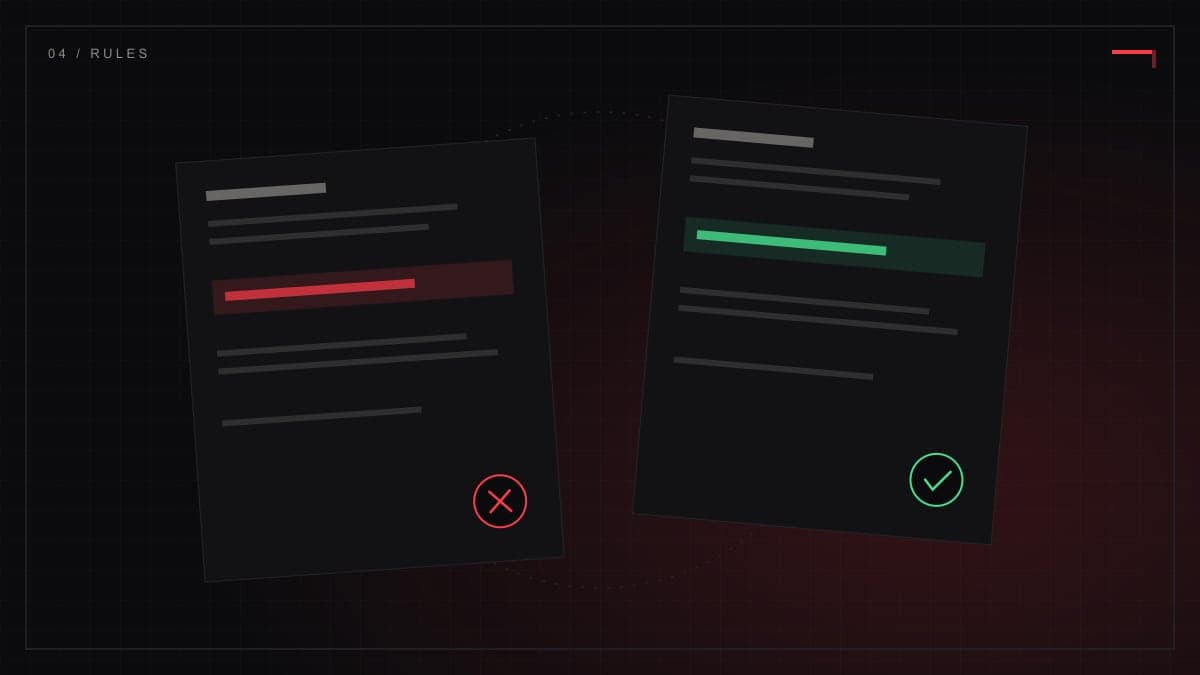
The math of a cross-venue arbitrage is simple: buy YES on one venue, NO on the other, and collect $1 if both markets resolve the same way. The hard part is the last clause.
Same words, different contract
One venue says “Will Bitcoin be above $80,000 on October 25 at 8am ET?” Another says “Bitcoin above $80,000 on October 25?” The first has a timestamp. The second might use the whole day. If the price touches $80,100 at 7am and falls to $79,900 by 9am, the two markets can resolve differently. The titles look almost identical.
The usual suspects
| What to compare | Why it matters |
|---|---|
| Resolution source | One venue may use an exchange, another a news desk or an index. |
| Cut-off time and time zone | An 8am ET snapshot is not the same as a full-day close. |
| Above vs at least | A market that pays at exactly $80,000 is not the same as one that needs $80,000.01. |
| Ties and edge cases | Postponed games, recounts, missing data and “no contest” rules can split the outcome. |
| Geography and wording | “US GDP” and “Eurozone GDP” are different contracts even when the rest of the title matches. |
How to read two rulebooks in five minutes
- 01Open both markets
Read the full description, not the scanner row. The title is a summary; the rules are the contract.
- 02Find the source and the clock
Write down the resolution source and the exact date and time, including the time zone.
- 03Circle the payout words
Above, at least, below, before, by, official, confirmed. One word can change the outcome.
- 04Search for the edge cases
Look for postponed, cancelled, tie, recount and “if the source is unavailable”.
- 05Compare, then decide
If the rulebooks disagree on any of those, treat the pair as a different trade. It might still be worth doing, but it is not a clean arbitrage.
The boring version: the best arb is usually the one where both rulebooks are short, specific and obviously the same. If you need a paragraph of interpretation, the edge is probably compensation for risk you have not priced.
The team behind the scanner. We write about cross-venue pricing, resolution rules and the mechanics of locking in spreads on prediction markets.